Vypolzovo — Podlesnovo
Ярославская область
A chain of church and town blocks between Uglich and Rostov: picturesque villages and empty churches, a monastery on the old road, a 17th-century kremlin above Lake Nero, and a run out into the fields ending at the church in Podlesnovo.
Description
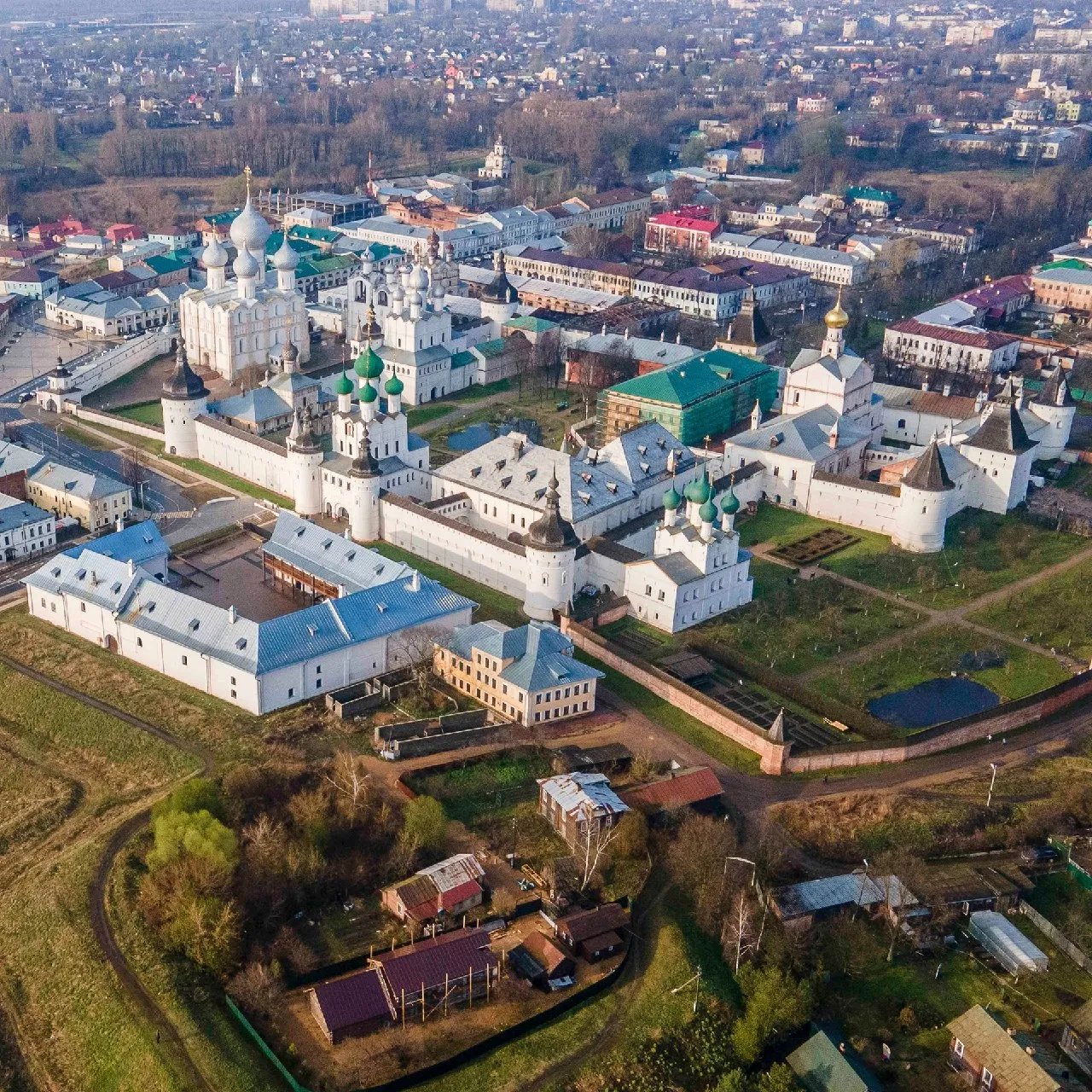
Vypolzovo — Zaozerye — Borisoglebsky — Rostov Veliky — Podlesnovo: abandoned churches, quiet villages and the ancient Yaroslavl land. This route crosses Yaroslavl Oblast — through old villages, abandoned churches, monastery walls, carved wood and one of Russia's oldest towns. There is almost no sense of a tourist showcase here: the road leads not only to the Rostov kremlin but also to places where history stands in the fields, sits empty behind closed gates and slowly sinks into silence. The route begins in Vypolzovo, at the abandoned Epiphany church of the late 18th century. The roof has partly collapsed, the half-ruined clergy houses stand nearby, but fragments of frescoes can still be seen inside. This immediately sets the tone of the trip: not parade-ground history, but a living, fragile and in places almost vanishing one. Next the road brings you to Zaozerye — one of Russia's most beautiful villages. The mood is entirely different: old Uglich land, the wooden 'House with Pike' of the merchant's widow Ustinya Roskova, carved patterns, copper gutter-pipes shaped like pikes and the memory of Saltykov-Shchedrin's childhood places. After Zaozerye the route returns to half-forgotten points — the empty churches of Gubachyovo and Derevenki, where dereliction feels not like stage scenery but as the true state of the rural interior. The route's main historical anchor is the Borisoglebsky monastery. Founded in the 14th century with the blessing of Sergius of Radonezh, it looks almost like a fortress: high walls, towers, ancient cathedrals and gate churches. Yet there is no sense of an overloaded tourist site — the cloister lives calmly, a little aside from the big routes. Then the road reaches Rostov Veliky, one of Russia's oldest towns. The white-stone kremlin, the Dormition cathedral, 17th-century towers and Lake Nero make this part of the route the most grand and recognisable. Rostov is especially striking in spring, when the water comes up to the streets and the churches reflect in the flood. After Rostov the route turns intimate again. Veksitsy, Klimatino and Podlesnovo are not about postcards but about roads through fields, lone brick churches, overgrown approaches and a rare sense of space. From Klimatino the tall bell tower of Porechye-Rybnoye is visible in the distance, and in Podlesnovo the church of John the Theologian stands amid the Yaroslavl expanses — without loud museum value, without crowds, simply as a trace of a departed life. The route suits those who love the north-eastern provinces without embellishment: abandoned churches, old villages, monastic architecture, wooden details and roads where the main value is not only the sight but the very feel of the place.
Route points
- 1Выползово
Пятиглавая кирпичная церковь Богоявления 1790 года на Козьмодемьянском погосте после закрытия заброшена, но внутри сохранились фрески на стенах.
- 2Заозерье
Село на Угличской земле с деревянным «Домом со щуками» (1860-е), резьбой лицового фасада и щуками с меди Николая Бородулина; здесь жил ребёнком Салтыков-Щедрин.
- 3Губачёво
Троицкая кирпичная церковь построена в 1809–1817 годах и после хрущёвских закрытий пустует.
- 4Деревеньки
Никольская церковь 1814 года с престолами Николая и Бориса и Глеба заброшена; вокруг — опустошение и запустение.
- 5Борисоглебский
Монастырь 1363 года с допетровским ансамблем собора и трапезной, кольцом стен с четырнадцатью башнями высотой до 40 метров и музеем при обители (с 2012 года).
- 6Rostov Veliky
An ancient town with a seventeenth-century kremlin, the Assumption Cathedral and Lake Nero.
- 7Вексицы
Церковь Георгия 1798 года на средства экономических крестьян стоит в конце дороги в полях и давно заброшена.
- 8Климатино
Спасо-Преображенская церковь Голицыной 1780 года с тремя престолами рядом с Поречьем-Рыбным; петропавловская колокольня высотой 94 м видна из села.
- 9Подлесново
Иоанно-Богословская церковь Ошаниных 1795 года с видами на область заброшена среди полей.