Ilmen and Staraya Russa
1–2 days · about 110 km · Novgorod Oblast
Khutyn, Yuriev, the spaciousness of Ilmen, Rurikovo Gorodishche and the mineral springs of Staraya Russa — a line from Novgorod monasteries to a resort city on the Polist.
Description
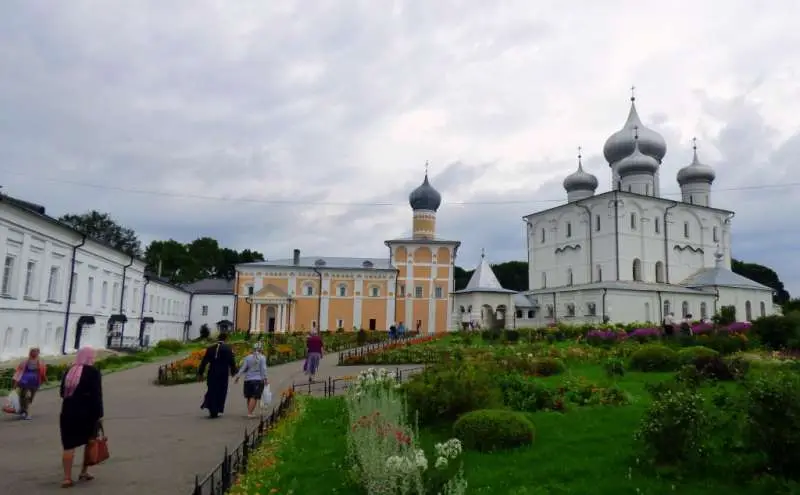
A line from north to south, from the environs of Veliky Novgorod to Staraya Russa: two functioning monasteries, the spaciousness of the flat lake and the city that lives on salt for more than a thousand years. About one hundred and ten kilometers of roads; if desired, the route can be easily stretched for two days — Staraya Russa is worth staying. Start is the Khutyn Monastery on the left bank of Polist, founded in the fourteenth century and connected with the memory of Archbishop Euthymius II: cathedral, bell tower, buildings and fence with towers, a living monastery twenty–thirty minutes from the city. A little further south is the Yuriev Monastery on the southern bank of Ilmen, one of the oldest in Rus': the legend links its foundation to Yaroslav the Wise, in olden times scriptoria worked here, and the main cathedral and bell tower were formed in the eighteenth–nineteenth centuries. The wind from Ilmen is strong here even in summer — a windbreaker will come in handy. Further the route comes out to the lake itself. Ilmen is one of the largest lakes of the Northwest with an area of over seven hundred square kilometers: the Lovat, Msta, Polist flow into it, and through the Volkhov it is connected with Ladoga. This is not a lake-resort, but a wetland expanse with birds, fishing according to the rules and horizons that the Novgorod Kremlin does not give; "to go around the entire lake" in a day will not work — choose one bank. The southern end of the line is Staraya Russa. First, Rurikovo Gorodishche on the right high bank of the Polist: ramparts, moats and the settlement territory with finds of the ninth–twelfth centuries — an open archaeological landscape without reconstructions, from where the river and the lowland part of the city are visible. Then is Russa itself, a resort with mineral springs that were used in the Middle Ages: since the nineteenth century balneological institutions, wooden galleries and a dacha atmosphere operate here. Water of different wells differs in composition, drinking from technical wells is not allowed, and procedures work by appointment; nearby is Dostoevsky house-museum and merchant streets that deserve a separate morning.
In catalog since November 7, 2026
Route points
- 1Khutyn Monastery
A working monastery a few kilometres from Veliky Novgorod — stone buildings from the 15th–19th centuries on the Polist, off the main Kremlin circuits.
- 2Yuriev Monastery
One of Rus's oldest monasteries on Lake Ilmen — stone cathedral, bell tower and quiet away from central Veliky Novgorod.
- 3Lake Ilmen
A large shallow lake in the oblast's south — wetlands, fishing, birds and views the Novgorod Kremlin cannot offer.
- 4Rurik Gorodishche
An ancient fort on the Polist near Staraya Russa — archaeological site with river views, tied to early Novgorod lands history.
- 5Staraya Russa Mineral Springs
An old spa town on salt springs — medicinal waters, a wooden promenade and 19th-century atmosphere away from Novgorod's main tourist hub.